Did someone on WhatsApp introduce you to Aelvy as a cross-border dropshipping opportunity selling luxury goods? Have you been told you need to top up your shop balance with cryptocurrency to keep orders moving?
This Aelvy scam review exposes every stage of one of the most sophisticated fake ecommerce fraud operations currently active. Aelvy presents itself as a legitimate American luxury goods dropshipping platform. In reality, scammers design this scripted trap to force victims to deposit crypto continuously under manufactured time pressure until they completely exhaust their funds.
Four victims across four countries lost between $40,000 and $200,000 combined. One victim alone lost $77,000 before their account was frozen without warning.
Read every section of this review before funding a single order. The information here could save your savings and your business.
What Is Aelvy?
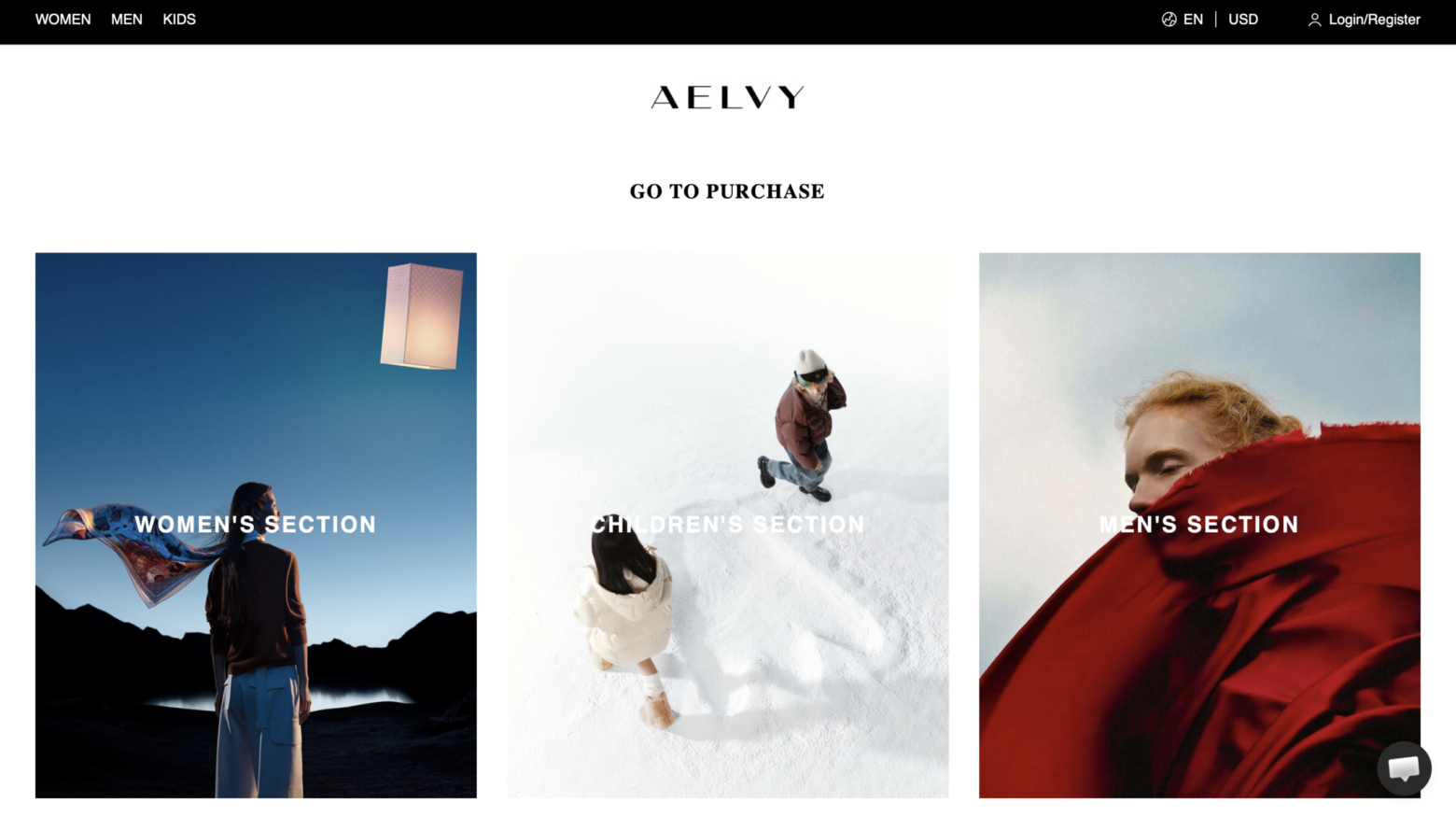
Aelvy operates through the website aelvy.com and presents itself as an American cross-border ecommerce platform. It offers sellers the opportunity to set up online shops selling luxury goods through a dropshipping model. Buyers place orders, the platform supposedly sources the goods from manufacturers, and the shop owner earns profit on the margin.
The platform is designed to look and feel exactly like a legitimate ecommerce business. It has professional branding, a structured onboarding process, a shop dashboard with a visible reputation score, and a customer service channel. Everything about its surface appearance suggests a real, operating business.
Beneath that surface, Aelvy is a fraudulent operation. It uses fabricated orders, manufactured time pressure, and a reputation score mechanic to force shop owners into making continuous cryptocurrency deposits. Once the fraud has extracted the maximum possible amount from a victim, all accounts are frozen without recourse.
The Federal Trade Commission has documented the rise of fake ecommerce platform fraud as one of the fastest-growing categories of online business fraud targeting entrepreneurs and side-income seekers in 2025. Aelvy is a well-structured example of this fraud type operating at an international scale.
How the Aelvy Fraud Recruits Victims
Aelvy does not advertise publicly. It does not run visible campaigns or post on mainstream business forums. Instead, it relies entirely on personal referral through WhatsApp, which serves two strategic purposes: it keeps the operation under public radar, and it exploits the built-in trust of a personal recommendation.
The WhatsApp Introduction
A person known to the victim, or someone who has built an online rapport with them, introduces Aelvy through WhatsApp. The pitch is framed as a genuine business opportunity. The referrer claims to be running a successful shop on the platform themselves and offers to guide the victim through the setup process.
Because the introduction comes from a known or trusted contact rather than from an unsolicited advertisement, the victim’s scepticism is significantly reduced. The referrer’s apparent personal success with the platform adds further validation.
This referral model is a deliberate design choice. The FBI Internet Crime Complaint Center has documented how fraud networks use trusted personal networks to recruit victims into fake business platforms specifically because personal referrals bypass the suspicion that cold outreach triggers.
The Assisted Setup
The referrer offers to personally help the victim set up their shop. This assistance feels generous and supportive. In practice, it ensures that the victim follows the exact onboarding pathway the fraud operation requires and becomes financially committed before they have had any opportunity to independently assess the platform.
The setup process is detailed and credible. The shop dashboard looks professional. The product listings appear legitimate. Scammers engineer the entire experience to feel like a real business launch, not the entry point of a financial trap.
How the Aelvy Fraud Works: Every Stage Exposed
Stage 1: Orders Begin Arriving Immediately
Once the shop is set up, orders start coming in quickly. This rapid early activity signals that the platform has real customers and genuine demand. The shop owner feels that they have made a smart business decision and that revenue is already beginning to flow.
These initial orders are fabricated. No real buyers are placing them. The fraud operation generates the orders specifically to begin the extraction cycle while the victim is still in the honeymoon phase of their new business.
Stage 2: The scheme reveals the 72-hour payment trap.
When orders arrive, the platform reveals the critical mechanic that drives the entire fraud. Every order blocks the buyer’s payment. The shop owner must pay the manufacturer directly within 72 hours, or the order will fail and damage their reputation score.
The 72-hour window is deliberately short. It creates constant urgency and prevents the shop owner from pausing to evaluate whether anything is wrong. The time pressure is always on. Every moment of hesitation feels like it is costing them money and reputation.
The Consumer Financial Protection Bureau specifically identifies manufactured time pressure as one of the most common and effective psychological mechanisms used in ecommerce and investment fraud. It bypasses rational evaluation by making immediate action feel more urgent than careful analysis.
Stage 3: The platform blocks contact with buyers.
When the victim attempts to contact buyers directly to clarify orders, resolve shipping issues, or verify the legitimacy of transactions, the platform blocks all direct communication. Shop owners cannot reach the people who are supposedly purchasing from them.
This restriction is not a standard ecommerce policy. It is a mechanism to prevent victims from discovering that the buyers do not exist. Real dropshipping platforms and genuine marketplaces allow seller-to-buyer communication within certain guidelines. Blocking it entirely removes any possibility of the victim verifying the orders independently.
Stage 4: Crypto Top-Ups Become Mandatory
To fulfil orders and avoid reputation score damage, the victim must continuously top up their shop balance with cryptocurrency. Small top-ups are required first. Then larger ones follow. The balance requirements increase steadily with each new batch of orders.
Cryptocurrency is required for all payments. This requirement ensures that every transaction is irreversible and untraceable across international borders. No credit card chargeback, no bank reversal, and no payment processor dispute is possible once cryptocurrency has been sent.
The reputation score mechanic is the most psychologically sophisticated element of this fraud. The platform tells victims that their score determines the volume and quality of orders their shop receives. A falling score means fewer orders and lower earnings. Maintaining it requires continuous crypto deposits.
This creates a self-reinforcing trap. The more the victim invests to protect their reputation score, the more committed they feel to the platform and the more reluctant they become to walk away from what they perceive as a growing business asset.
Security researchers at the Stanford Internet Observatory have documented reputation score mechanics as a newly emerging feature of fake platform fraud, designed specifically to make victims feel that walking away means forfeiting everything they have already built.
Stage 5: The platform blocks attempts to close the shop.
When victims become suspicious and attempt to close their shops or withdraw any funds, new rules appear that prevent them from doing so. Platform terms are updated. New requirements are introduced. Closure requests are denied on procedural grounds.
This stage reveals the trap in full. The shop was never closeable on the victim’s terms. Every policy and every rule within the platform exists to keep money flowing in and to prevent any of it from flowing out.
The victim in this review attempted to close their shop after another shop owner warned them it was a fraud. The closure was blocked. New restrictions appeared immediately.
Stage 6: The system freezes accounts simultaneously.
Once the fraud operation extracts the maximum possible amount from each victim, it freezes all accounts without warning or explanation. Shop balances, withheld buyer payments, and any funds sitting in the platform account become permanently inaccessible.
In the documented case reviewed here, at least four shop owners across four countries had their accounts frozen simultaneously. The coordinated nature of this final step confirms that a central operation runs the scheme and that the freeze is not a platform error or a dispute outcome. It is the planned conclusion of a scripted extraction cycle.
Documented Victim Account: $77,000 Lost Across Four Countries
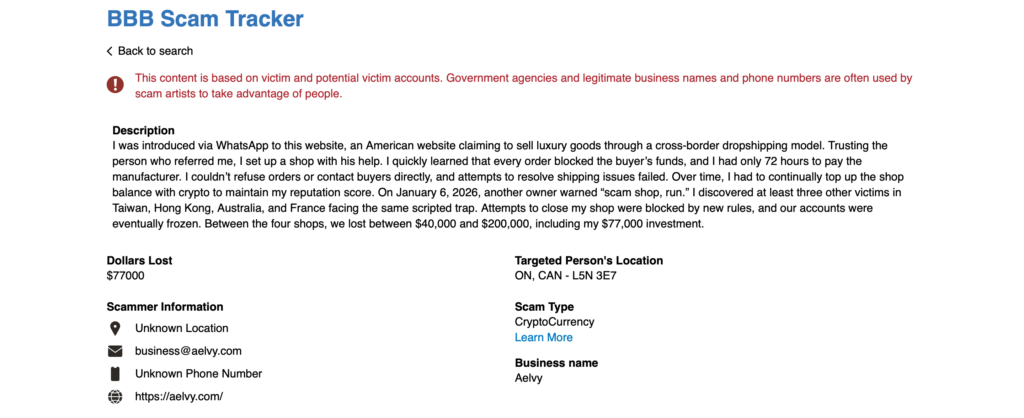
A victim from Ontario, Canada, shared their experience in a formal fraud complaint filed in April 2026. Their account is among the most detailed and internationally significant ecommerce platform fraud reports in recent public records.
The victim was introduced to Aelvy through WhatsApp by a trusted contact. They set up a shop with the referrer’s help and quickly began receiving orders. The 72-hour payment requirement became clear immediately, as did the restriction on contacting buyers.
Over time, the victim continued topping up their shop balance with cryptocurrency to fulfil orders and protect their reputation score. The amounts required grew progressively. Attempts to resolve shipping issues through the platform failed without explanation.
On January 6, 2026, another shop owner sent a warning message: “scam shop, run.” The victim began investigating and discovered at least three other victims in Taiwan, Hong Kong, Australia, and France facing the identical scripted trap with identical platform behaviour.
Attempts to close all four shops were blocked by new rules introduced specifically to prevent exit. All four accounts were eventually frozen. The combined losses across the four shops ranged between $40,000 and $200,000. The victim who filed this report lost $77,000 of their own investment.
The coordinated, multi-country, simultaneous nature of this operation confirms that Aelvy is not a legitimate business with operational problems. It is an organised international fraud network with a predetermined extraction and exit script.
The International Scale of the Aelvy Operation
One of the most important and underreported aspects of this fraud is its deliberate multi-country structure. Victims were identified in Canada, Taiwan, Hong Kong, Australia, and France. All faced identical conditions, identical platform behaviour, and identical outcomes.
This is not coincidental overlap. An operation that recruits victims across five countries simultaneously, presents them with the same scripted traps, and freezes all accounts at the same time is a centralised, professionally run fraud network.
International fraud operations of this structure are specifically investigated by the US Department of Justice and by INTERPOL’s Financial Crimes unit. The cross-border nature of the victim pool actually strengthens the case for coordinated law enforcement action because it establishes the operation’s international scope and its organised character.
Every victim who files a formal report in their jurisdiction adds to the cross-border investigative record that makes prosecution of international fraud networks possible.
Why the Aelvy Fraud Is Harder to Identify Than Most
Most investment fraud follows a recognisable emotional pattern: scammers build a relationship, introduce a financial opportunity, and request a payment. Aelvy avoids this pattern entirely by making the victim feel like they are running their own legitimate business.
It operates as a business model, not an investment pitch. The scammer does not ask the victim to invest money in someone else’s scheme. Instead, they give the victim their own shop, their own dashboard, and their own orders. They feel like an entrepreneur, not a victim. This is a fundamentally different psychological position that is much harder to recognise as fraud from the inside.
The platform behaves like real ecommerce software. The dashboard, the order management system, the reputation score, and the product listings all function as expected. Nothing appears broken or suspicious at the surface level. The fraud operates through the rules and mechanics of the system, not through obvious deception.
The referral model neutralises suspicion. Because the victim was introduced by a known contact, they carry an implicit endorsement into every interaction with the platform. Questioning Aelvy feels like questioning the judgment of the person who referred them, which most people are reluctant to do.
The reputation score creates psychological ownership. After weeks of building their reputation score through crypto top-ups, victims feel that they own something valuable on the platform. Walking away from a high reputation score feels like destroying their own asset, even though the asset is completely fabricated.
The 72-hour clock prevents rational decision-making. Every moment of the fraud experience is accompanied by time pressure. There is never a quiet moment to step back and evaluate the situation clearly. The urgency is permanent and manufactured.
Red Flags That Identify Aelvy as a Fraudulent Platform
Every element of the Aelvy operation contains recognisable warning signs. Knowing them before you encounter them is the most effective protection available.
Introduction exclusively through personal WhatsApp referral with no public presence. Legitimate ecommerce platforms advertise publicly, list on trusted business directories, and have verifiable reviews across independent review sites. A platform that recruits only through personal messaging is deliberately avoiding public scrutiny.
Orders that block buyer funds and require seller payment within 72 hours. In real dropshipping, the seller collects payment from the buyer before purchasing inventory from a supplier. A model where the buyer’s payment is blocked and the seller must fund the manufacturer upfront is financially inverted and has no legitimate precedent in standard ecommerce practice.
No ability to contact buyers directly. Every credible ecommerce marketplace, from Amazon to Etsy to Shopify, allows some form of seller-to-buyer communication for order clarification and customer service. Blocking this communication entirely removes the seller’s ability to verify that buyers exist.
All payments in cryptocurrency only. No legitimate ecommerce platform requires all seller transactions exclusively in cryptocurrency. This requirement is chosen specifically because cryptocurrency transfers are irreversible and cannot be disputed or recalled.
A reputation score that can only be maintained through ongoing deposits. Real platforms like eBay and Trustpilot build reputation systems through customer feedback, not through financial deposits. Any platform that requires payment to maintain or improve a reputation score is using that score as a deposit extraction mechanism.
Inability to close your account or withdraw funds. Every legitimate business platform allows account closure and fund withdrawal within defined terms. The platform introduces new blocking rules whenever you attempt to exit because its designers built it from the start to prevent any exit.
How to Verify Any Dropshipping or eCommerce Platform Before Joining
Protecting yourself begins with verification steps that take minutes but could prevent losses of tens of thousands of dollars.
Search the platform name alongside “fraud,” “warning,” and “review” before joining. Victim reports and regulatory alerts often surface quickly for newly operating fraud platforms. A brief search before you set up any shop could reveal everything you need to know.
Check the domain registration date. Use WHOIS DomainTools to find when aelvy.com was registered. A newly created domain presenting itself as an established business platform is a serious red flag regardless of how professional the website looks.
Search for the platform on independent review sites. Check Trustpilot, Sitejabber, and the Better Business Bureau for any reviews or complaints. The complete absence of independent reviews for a platform claiming to have active sellers worldwide is itself a warning sign.
Verify the business registration. Aelvy claims to be an American company. Search for it on the US Securities and Exchange Commission’s company database and on state business registries. A company with no verifiable legal registration is not a real business.
Never use cryptocurrency as your only payment method for a business platform. Any platform that refuses all payment methods except cryptocurrency should be treated as high-risk immediately. The absence of bank transfer, credit card, or PayPal options removes all consumer protections that legitimate payment systems provide.
Test any platform’s withdrawal process before committing meaningful funds. Deposit the smallest possible amount and immediately attempt to withdraw it. If any barrier appears, treat the platform as confirmed fraudulent.
Talk to existing sellers independently. Ask to speak with other sellers through channels outside the platform itself, not through a WhatsApp group or platform chat where accounts could be fake. Genuine sellers of a legitimate platform will be reachable and verifiable independently.
Aelvy vs a Legitimate Cross-Border Dropshipping Platform
| Feature | Aelvy | Legitimate Dropshipping Platform |
|---|---|---|
| Recruitment method | Personal WhatsApp referral only | Public listings, verified directories |
| Payment model | Seller pays manufacturer before buyer funds clear | Buyer payment clears before seller pays supplier |
| Seller-to-buyer communication | Completely blocked | Allowed within standard marketplace guidelines |
| Payment method | Cryptocurrency only, irreversible | Bank transfer, card, or verified payment systems |
| Reputation score mechanic | Maintained through ongoing crypto deposits | Built through genuine customer feedback |
| Account closure | Blocked by new rules whenever attempted | Straightforward with clear terms |
| Fund withdrawal | Permanently blocked | Processed within stated timelines |
| Business registration | Unverifiable | Publicly registered and auditable |
| Independent reviews | None found | Verifiable on Trustpilot and similar sites |
| Victim geography | Multiple countries, identical experiences | Diverse, genuine, verifiable user base |
Frequently Asked Questions About Aelvy
Is Aelvy a legitimate dropshipping platform? No. Aelvy operates as a fraudulent ecommerce platform that extracts cryptocurrency from shop owners through a scripted order-blocking and reputation score top-up trap. It lacks any verifiable business registration, has no independent reviews, and follows a documented pattern of freezing all accounts once it achieves maximum extraction. Multiple victims across five countries have reported identical experiences.
How does the Aelvy scam work exactly? Scammers contact victims through WhatsApp and help them set up a shop. Orders arrive immediately, but the platform blocks the buyer’s payment. The seller must pay the manufacturer within 72 hours using cryptocurrency or their reputation score drops. This cycle of blocked orders and mandatory crypto top-ups continues until the victim’s funds are exhausted, after which all accounts are frozen simultaneously.
Why does Aelvy require cryptocurrency for all payments? Cryptocurrency transactions are irreversible and very difficult to trace across international borders. Requiring cryptocurrency exclusively eliminates all possibility of chargebacks, payment disputes, or bank reversals. Every dollar sent through cryptocurrency to Aelvy is permanently unrecoverable through standard financial channels.
What is the reputation score mechanic and why is it used?
The platform fabricates the reputation score and claims it determines the volume and quality of orders a shop receives. It tells victims they must maintain their score through regular crypto deposits, or their business will suffer. In reality, the score exists solely to create a reason for continuous deposits. It has no connection to any real business metric or customer feedback system.
A Note to Every Victim of the Aelvy Fraud
Losing money through a business fraud carries a particular kind of pain that is different from other financial losses. You were not making a speculative bet, you were building something, and you were following a business model that appeared coherent, credible, and supported by someone you trusted.
The sophistication of the Aelvy operation is precisely what makes it so devastating and so difficult to identify from the inside. The platform looked like a real business. The orders looked real. The reputation score felt like something genuinely yours to protect. None of it was.
What happened to you was the result of a professional criminal network that has refined this specific fraud model across multiple countries and multiple victims. That is not a reflection of your judgment. It is a reflection of how well-engineered this fraud is.
If you are struggling emotionally with what happened, please reach out for support.
Final Verdict: Aelvy Is a Sophisticated, Internationally Coordinated Fraud
Aelvy is not a dropshipping platform. It is an organised, multi-country fraud operation using a fake ecommerce business model to extract cryptocurrency from entrepreneurs and side-income seekers who have no reason to suspect the business itself is the deception.
Its combination of fabricated orders, blocked communications, reputation score mechanics, 72-hour payment pressure, and coordinated account freezes represents a new and particularly difficult-to-detect evolution in ecommerce fraud.
Victims across five countries have already paid the price. The combined documented losses run into hundreds of thousands of dollars. The true number of victims is almost certainly higher than those who have filed formal reports.
If you have been targeted, stop all payments immediately, document everything, and report across every available channel. Share this article with anyone you know who is considering a dropshipping or cross-border ecommerce opportunity through WhatsApp or a personal referral.
One share of this review could prevent someone from losing everything they have worked to build.