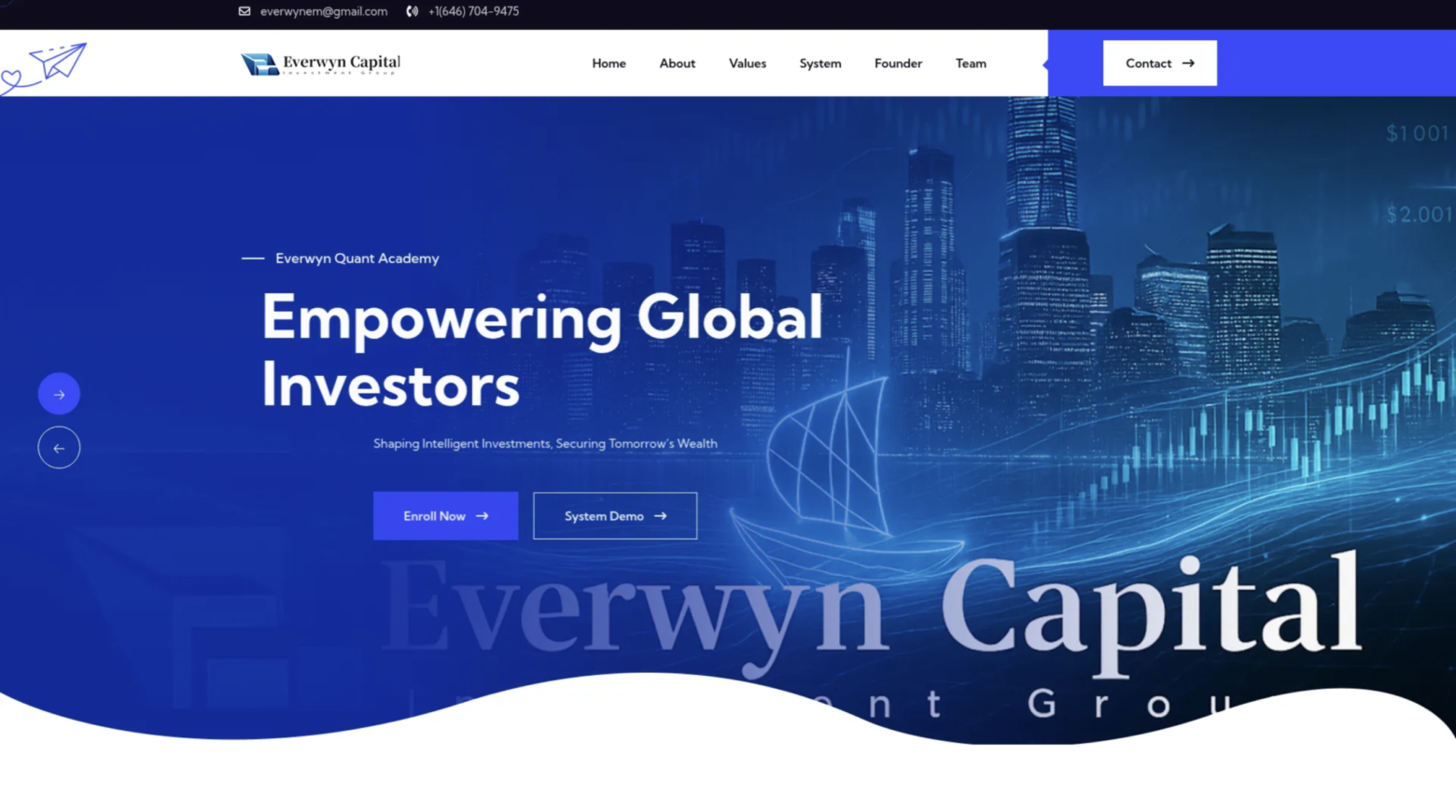
If you searched for an Everwyn Quant Academy scam review, you made the right call. This review exposes exactly how Everwyn Quant Academy operates a fraudulent crypto investment scheme through WhatsApp, targeting everyday people with fake AI trading signals and a manipulative fake Professor. One verified victim, a retired woman living on a fixed income in New York, lost $54,000 including money she took out in personal loans and nearly lost through a home equity loan.
Do not join any group, send any screenshots, or transfer any money connected to Everwyn Quant Academy. Read every section below first.
What Is Everwyn Quant Academy?
Everwyn Quant Academy presents itself as an exclusive investment education community. It claims to teach members how to profit from stocks and cryptocurrency using a proprietary AI signal system developed by a character called “the Professor.” Members are placed into WhatsApp groups and given buy and sell signals to follow. The concept sounds structured, academic, and legitimate.
In reality, Everwyn Quant Academy is a fraud operation. There is no real Professor, there is no proprietary AI system, and there is no functioning trading platform. Scammers design the setup to build trust and persuade victims to transfer large sums into a platform they can never withdraw from.
The Washington State Department of Financial Institutions published a formal consumer alert specifically warning about this exact type of scheme, fake investment academies run by self-proclaimed Professors in WhatsApp groups. Everwyn Quant Academy matches every single pattern described in that alert.
Who Runs Everwyn Quant Academy?
The true identities behind Everwyn Quant Academy are unknown. Victims interact with recruited agents who use first names and friendly personas. In the confirmed fraud case reported to the BBB in April 2026, the primary contact used the name Heidi Stephens. Heidi acted as a recruiter and guide, walking the victim through every step of the process.
Heidi presented herself as a fellow investor and group member. She directed the victim step by step, told them what amounts to invest, which level to select, and walked them through moving funds to a platform called vesxbot. When the victim ran out of money, Heidi pushed her to take out personal loans and a home equity loan to continue funding the scheme.
This recruiter role has a specific name in fraud investigation: a “money mule handler.” The Washington State DFI notes that recruiters in these schemes often pose as assistants or fellow students while they actually run the fraud operation.
How the Everwyn Quant Academy Scam Works: Full Step-by-Step Breakdown
This scam is sophisticated and patient. It uses a well-documented fraud method that security researchers call a pig butchering scam, where criminals build genuine-feeling trust before extracting everything. Here is exactly how Everwyn Quant Academy runs its version of this scheme.
Step 1: The Friendly Introduction
LoreThe scammer approaches the target through social media or direct messaging. In the confirmed case, Heidi Stephens contacted the victim, invited them to join a group of investors, and presented the offer as casual and social rather than pushy. There is no mention of large sums of money at this stage.
Step 2: The AI Signal Group
The victim is invited into a WhatsApp investment group. Inside the group, a character referred to as “the Professor” shares buy and sell signals. The signals are described as being generated by a proprietary AI system that is currently being tested. Members are asked to take screenshots of their trades and send them to Heidi. This screenshot requirement creates a sense of participation and accountability. It also helps the scammer assess how engaged and trusting the victim is becoming.
Step 3: The Pivot to Crypto
After an initial period of stock signals, the Professor announces that the group is moving into cryptocurrency. This is a calculated shift. Scammers choose cryptocurrency because transactions are irreversible and hard to recover. They use announcements to create urgency and a sense of opportunity.
Step 4: The Investment Level Selection
Members are told there are three investment groups based on how much they are willing to put in. The victim in the confirmed case chose the lowest available level. That level required a deposit of $33,000. The money was sent to a Trust Wallet and then directed, screenshot by screenshot under Heidi’s guidance, into a platform called vesxbot.
The CFTC has specifically warned that claims of AI-generated trading signals producing exceptional returns are a primary red flag of investment fraud. No AI system can predict market movements or guarantee returns. These signals are entirely fabricated to build confidence.
Step 5: The Promised Return That Never Comes
The victim was told that their $33,000 level would earn 45% per week for three weeks, resulting in a total of $100,000. This promise is designed to feel within reach and specific enough to sound credible. The platform dashboard showed growing balances. The Vesxbot interface fabricates those numbers to keep victims engaged and stop them from attempting early withdrawals.
Step 6: The Forced Level Upgrade
Before the three weeks were up, Heidi announced the discontinuation of the lower investment level. The victim would need to upgrade their personal investment to $100,000 to remain in the programme. This sudden rule change is a classic pressure tactic documented across dozens of similar academy scams by the Washington State DFI.
Step 7: Pressure to Borrow Money
When the victim said she could not afford to reach $100,000, Heidi did not accept that answer. She encouraged the victim to apply for personal loans. The victim applied for a loan but was denied because she is retired and on a fixed income. Heidi then suggested a home equity loan. She also offered to add funds with the academy, which the victim could repay later from profits.
Also, the victim ultimately applied for a home equity loan and came up with an additional $21,000 of her own money against her better judgement. She had been slowly conditioned over weeks to trust Heidi completely.
Step 8: Daily Pressure for More
Even after the upgraded payment, Heidi contacted the victim every day with new scenarios designed to increase the home equity loan by an additional $40,000. At this point, the victim refused and drew a firm line. She cancelled the home equity loan application before it funded and stopped further losses.
Step 9: The Frozen Account and Worthless Balance
When the victim tried to withdraw funds from her Trust Wallet, she found a balance showing over $208,000 locked in Futures, but zero available to trade or withdraw. Also, the money exists only as a number on a fraudulent screen. It cannot be moved, accessed, or recovered through the platform.
The scam was complete. Total losses reached $54,000.
Real Victim Account: $54,000 Lost by a Retired New Yorker
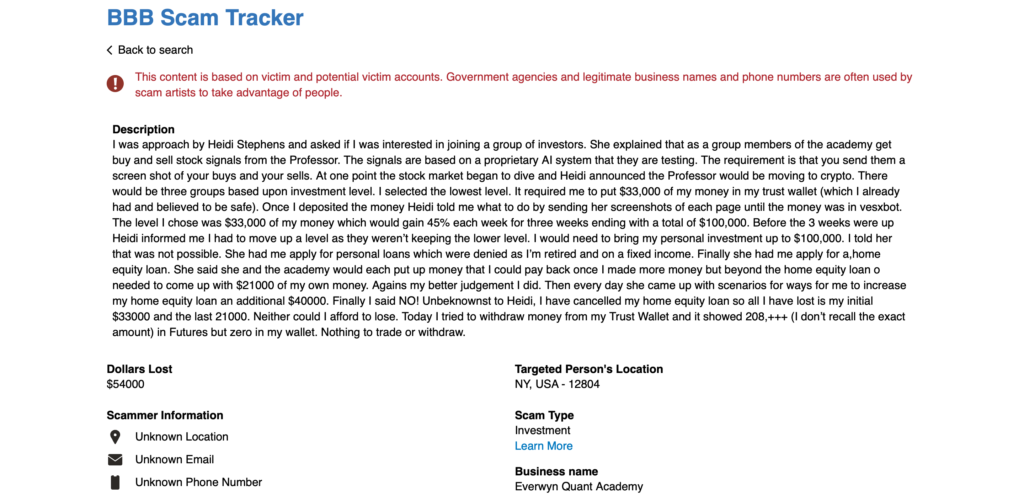
The fraud report filed with the BBB Scam Tracker on April 28, 2026 describes the full experience in the victim’s own words. Key facts from the report:
- Recruited through WhatsApp by a contact named Heidi Stephens
- Funds directed into vesxbot through Trust Wallet
- Promised 45% weekly returns over three weeks
- Pressured to apply for personal loans after initial investment
- Pressured to take out a home equity loan for an additional $100,000 upgrade
- Home equity loan cancelled in time, preventing further loss
- Trust Wallet showed $208,000+ in Futures — none accessible or withdrawable
- Total confirmed loss: $54,000
The victim described the experience plainly: she acted against her better judgement because the relationship with Heidi felt real, the platform looked convincing, and the promised returns seemed just believable enough to trust.
The vesxbot Platform: What It Actually Is
Vesxbot is the fraudulent trading platform used to receive and trap victim funds in this scheme. It is not a regulated exchange. It is not a real trading environment. The platform is a custom-built fraud tool designed to display fake balances, fake trade histories, and fake profit figures.
The CFTC warns explicitly that fraudulent platforms of this type replicate the look and feel of legitimate exchanges, show artificial gains to build confidence, and then block all withdrawals once sufficient funds have been deposited. Vesxbot operates exactly this way. The $208,000 figure shown on the victim’s screen was never real money. It was a number placed there to keep her investing.
The Government Warning That Matches Everwyn Quant Academy Exactly
The Washington State Department of Financial Institutions published a formal alert titled “Ongoing Trend of Alleged Cryptocurrency Scams Involving Self-Proclaimed Professors in WhatsApp Groups.” This alert was issued after DFI received multiple complaints about fraudulent companies claiming to be investment academies. Every element of that alert describes Everwyn Quant Academy:
The academy structure. The DFI notes that these scams use names like “Business School,” “Academy,” or “Wealth Institute” to appear educational and credible. Everwyn Quant Academy uses this positioning precisely.
The Professor figure. The DFI confirms that a Professor or founder role is central to these schemes, providing signals through WhatsApp that promise extraordinary returns.
The assistant recruiter. The DFI describes how a friendly assistant facilitates communication and builds trust with individual investors. In the Everwyn case, Heidi Stephens filled this exact role.
The VIP level structure. DFI organizes victims into investment tiers and pressures them to upgrade once they hit a cap. Everwyn Quant Academy used three investment tiers with forced upgrades.
The loan pressure tactic. DFI specifically warns that these schemes push victims to take out personal loans, home equity loans, and lines of credit to meet investment requirements. Heidi Stephens encouraged all three.
The frozen withdrawal. The DFI confirms that no investor in these schemes has ever successfully withdrawn funds by paying additional fees or repaying fake loans. Also, victims always lose everything deposited.
Red Flags Every Investor Must Recognise
These warning signs appear in every version of the Everwyn Quant Academy fraud type. Watch for all of them:
A stranger recruits you into a private investment group. No legitimate academy or trading community cold-recruits members through WhatsApp or social media messages.
A Professor provides AI-generated signals with guaranteed returns. The CFTC has stated directly that AI cannot predict markets or guarantee returns. Any claim of this kind is a fraud red flag.
You are asked to screenshot every step. This is a control tactic. It helps the handler guide victims smoothly toward the platform without independent research or hesitation.
Returns of 45% per week are promised. No legitimate investment produces consistent weekly returns of this size. The FBI’s Internet Crime Complaint Center documents that guaranteed high returns are one of the most consistent features of investment fraud.
Investment levels require large minimum deposits. Real educational communities do not require $33,000 minimum buy-ins. Real educators do not sort members by how much they can afford to lose.
You are pressured to borrow money to invest. This is one of the most alarming red flags in all of financial fraud. Legitimate investment professionals never encourage clients to take on debt to fund speculative positions.
Funds can be seen but not withdrawn. Scammers display a fake balance in a Futures account to prevent you from moving funds or leaving the platform.
Is Everwyn Quant Academy Regulated or Licensed?
No. Everwyn Quant Academy holds no licence from any recognised financial regulatory body. It is not registered with the SEC, CFTC, FINRA, or any state securities regulator. The vesxbot trading platform is similarly unregistered and unregulated.
Real investment advisers and trading platforms are required by law to register with the relevant authority in each country where they operate. You can verify any investment firm through the SEC’s Investment Adviser Public Disclosure databaseor the CFTC’s registered firms page. You will find no listing for Everwyn Quant Academy or vesxbot in either database.
The California Department of Financial Protection and Innovation notes in its crypto scam tracker that signal-selling scams using proprietary AI systems are among the most reported fraud types in 2025 and 2026. Everwyn Quant Academy is one active example of this growing trend.
How to Verify Any Investment Academy Before You Join
Apply these five checks before joining any group, sending any screenshots, or transferring any funds.
Search the academy name plus “scam” before anything else. The fact that you searched for this Everwyn Quant Academy scam review before committing your money is exactly the right instinct. Always trust that instinct.
Verify regulatory registration independently. Search the platform and the academy name on the SEC EDGAR database, the FINRA BrokerCheck tool, and your country’s financial regulator. Legitimate firms appear in these records.
Treat WhatsApp investment groups with immediate suspicion. The Washington State DFI confirmed in its published alert that receiving investment wire instructions or deposit guidance through WhatsApp is one of the clearest red flags of this specific fraud type.
Question any guaranteed return above market norms. Stock markets average roughly 10% per year. A promise of 45% per week is not a bold claim, it is a lie. The CFTC is clear that no AI system can generate these returns legitimately or consistently.
Never borrow money to invest in any platform introduced online. End all contact immediately and report anyone who urges you to take out a loan to invest in their platform, no matter how trustworthy they seem.
Final Verdict: Everwyn Quant Academy Scam Review Summary
Everwyn Quant Academy is a fraud operation. This Everwyn Quant Academy scam review confirms the following facts based on a verified victim report and matching government alerts:
A contact named Heidi Stephens recruited a retired New York victim through WhatsApp, guided her into Vesxbot via Trust Wallet, promised 45% weekly returns, and pressured her to take out personal loans and a home equity loan. Her account showed over $208,000 in a Futures balance she could never access. She lost $54,000 in total.
The Washington State Department of Financial Institutions has published a formal consumer alert describing this exact type of Professor academy WhatsApp scam. Everwyn Quant Academy matches every characteristic listed in that alert.
If someone has introduced you to Everwyn Quant Academy, stop all contact today. Report the scheme to the FBI IC3 and the CFTC. Share this page so others searching for an Everwyn Quant Academy review find the truth before they lose anything.
Frequently Asked Questions About Everwyn Quant Academy
Is Everwyn Quant Academy a scam?
Yes. Everwyn Quant Academy is a fraudulent investment scheme. It uses a fake Professor, a WhatsApp signal group, and a fraudulent trading platform called vesxbot to steal money from victims. A verified BBB report filed in April 2026 confirms a $54,000 loss.
What is vesxbot?
Vesxbot is the fraudulent trading platform used by Everwyn Quant Academy to receive victim funds. It displays fake balances and fabricated profits. Withdrawals are impossible regardless of the balance shown on screen.
Who is Heidi Stephens?
Heidi Stephens is the name used by the recruiter in the confirmed Everwyn Quant Academy fraud case. She acted as a friendly assistant, guided the victim step by step, and pressured her to borrow money to continue investing. Her true identity is unknown.
Is vesxbot a regulated trading platform?
No. Vesxbot is not registered with the SEC, CFTC, FINRA, or any other recognised financial authority. It is a fraudulent platform purpose-built to trap deposited funds.
Has any government authority warned about this type of scam?
Yes. The Washington State Department of Financial Institutions published a formal consumer alert about Professor cryptocurrency academy scams on WhatsApp. That alert describes Everwyn Quant Academy’s methods in precise detail. The CFTC has also issued a specific advisory warning about AI trading signal scams of this type.