TrustQuant Scam: How a Fake ETH AI Arbitrage Platform Stole $394,000 From a Trusting Investor
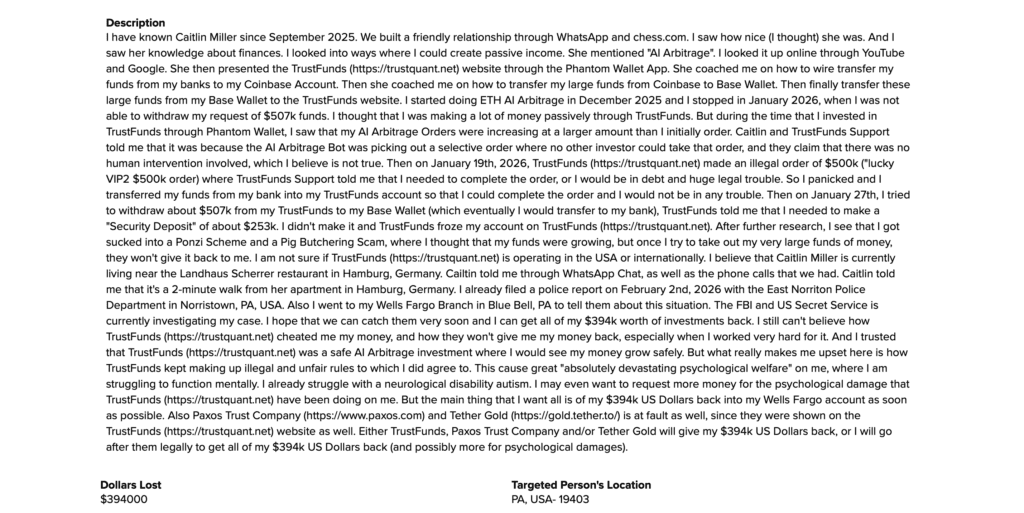
If you have been introduced to TrustQuant marketed under the name “TrustFunds” through a romantic connection, stop everything. Read this article before you transfer another dollar. TrustQuant is not an ETH AI arbitrage investment platform. It is a fraudulent operation running one of the most methodically documented pig butchering scams. With at least one confirmed victim losing $394,000 in after being manipulated over several months. The TrustQuant scam has been reported to the FBI, the US Secret Service, and local law enforcement. This article documents every detail of how it works and the steps victims need to take.
What Is TrustQuant / TrustFunds?
TrustQuant operates through the website trustquant.net and presents its platform to users under the name TrustFunds. It markets itself as an ETH AI arbitrage trading platform, a system that claims to use artificial intelligence to automatically identify and execute profitable arbitrage opportunities across cryptocurrency exchanges, generating passive income for investors without requiring active trading decisions.
The platform is accessed through the Phantom Wallet App, a legitimate cryptocurrency wallet that TrustQuant fraudulently exploits as a transfer gateway. Investors are coached step by step, first to wire funds from their bank to a Coinbase account, then from Coinbase to a Base Wallet, and finally from the Base Wallet to the TrustFunds platform. This multi-step transfer process serves a specific purpose: it creates distance between the victim’s bank and the fraudulent platform, making fund recovery significantly more difficult.
TrustQuant is not registered with the Securities and Exchange Commission (SEC), not listed with the Commodity Futures Trading Commission (CFTC), and does not appear on any recognised financial regulator’s database anywhere in the world. It has no verifiable ownership, no named leadership, no audited financials, and no regulated entity standing behind any of its promises. What it does have is a professionally designed interface, fabricated arbitrage order data, and a team of operators willing to spend months building the trust necessary to extract everything a victim has.
One Victim's Story: How TrustQuant Took $394,000
The account shared by one TrustQuant victim is among the most detailed and completely documented cases of this fraud pattern to be made public. It deserves to be told in full, because every stage of what happened to this person is happening to others right now, and recognising the sequence could prevent the next loss.
The Friendship That Started It All
The fraud began in September 2025, not with a financial pitch but with a friendship. The victim met a woman named “Caitlin Miller” through chess.com, a legitimate online chess platform. The platform is increasingly exploited by romance fraudsters for its built-in social interaction features. Their relationship developed through WhatsApp conversations over several months. Caitlin presented herself as financially knowledgeable, warm, and trustworthy. She appeared to genuinely care about the victim’s financial wellbeing.
In December 2025, Caitlin introduced the concept of ETH AI Arbitrage, a form of passive income she claimed had transformed her own financial situation. She directed the victim to search for it online, which he did. She then presented TrustFunds through the trustquant.net website and the Phantom Wallet App. Then patiently coached him through every step of setting up and funding the account.
The Platform Appeared to Work
Initial returns were impressive. The AI Arbitrage Bot appeared to execute trades and generate consistent profits, all displayed on a professional-looking dashboard. However, the victim noticed something troubling early on: his arbitrage orders were increasing to amounts significantly larger than he had originally placed. When he raised this with both Caitlin and TrustFunds Support, he was told the AI was selectively identifying premium arbitrage opportunities unavailable to other investors, and that there was no human intervention in the process.
He had his doubts. But the platform continued to show growth, and the relationship with Caitlin continued to feel genuine. He continued investing.
The Illegal $500,000 Order and the Panic Trap
On January 19th, 2026, TrustFunds placed what it called a “Lucky VIP2 $500,000 order” on the victim’s account, an order he had not authorised and had not placed. TrustFunds Support contacted him and told him he was required to complete this order immediately, or he would be placed in debt and face serious legal consequences. He panicked. Believing the threat was real, he transferred additional funds from his bank into his TrustFunds account to complete the order.
This tactic, the unauthorised order combined with a legal threat. It’s a documented escalation technique used in the final extraction phase of pig butchering fraud. It is designed to create acute panic that overrides rational judgment. It worked exactly as intended.
The $253,000 Security Deposit and the Account Freeze
On January 27th, 2026, the victim attempted to withdraw approximately $507,000 from TrustFunds to his Base Wallet. TrustFunds refused the withdrawal and demanded a “Security Deposit” of approximately $253,000 as a condition of releasing the funds. He declined to pay. TrustFunds immediately froze his account.
In total, the victim lost $394,000 in investment funds. All communication from TrustFunds subsequently stopped. Caitlin Miller went silent. Every contact associated with the platform disappeared simultaneously.
The victim has since filed a police report with the East Norriton Police Department in Norristown, Pennsylvania. Visited his Wells Fargo branch in Blue Bell, PA to document the fraud. Also confirmed that both the FBI and the US Secret Service are actively investigating his case. He has copies of all communications and has documented the full transaction history.
How the TrustQuant Pig Butchering Scam Works: The Full Playbook
The experience documented above is not a one-off incident. It is the precise, predictable sequence of a pig butchering operation. A fraud model that the FBI, Secret Service, and CFTC have documented in detail. It’s currently being pursued at the highest levels of US law enforcement.
Stage 1 - The Long Relationship Build
Pig butchering scammers use a variety of methods to establish a relationship, social, romantic, or business-focused. Then gradually introduce the victim to a fraudulent investment opportunity. In most cases, scammers approach victims through social media or dating apps, ask to take the conversation offline. Then to WhatsApp or WeChat, and then communicate regularly with the victim to establish the relationship.
The chess.com recruitment used in this case reflects a deliberate evolution in targeting strategy. Large language models allow bad actors to generate fake personas to build trust with victims. Tailor messages with improved cultural or regional context to appear more legitimate, and reduce the need for human oversight.
The “Caitlin Miller” persona, engaging, financially knowledgeable, emotionally warm. May have been partially or wholly AI-assisted, with human operators stepping in for key financial conversations.
Stage 2 - The AI Arbitrage Hook
AI-related pig butchering sites typically use buzzwords and jargon designed to give a sense of technological sophistication and legitimacy. An “AI intelligent trading system” with “adaptive ability to discover arbitrage between several major global cryptocurrency exchanges” is a standard template. These platforms support automatic monitoring and real-time trade execution language specifically to appear credible to investors unfamiliar with how arbitrage actually works.
Real cryptocurrency arbitrage opportunities exist, but they last milliseconds and are exploited by institutional trading desks with co-located servers and algorithmic infrastructure worth millions of dollars. A website accessible through a consumer cryptocurrency wallet offering guaranteed arbitrage returns to retail investors is, without exception, not operating a real arbitrage system. The returns displayed on the TrustFunds dashboard were fabricated data on a closed platform, not the product of real market activity.
Stage 3 - The Coached Transfer Chain
One of the most operationally distinctive elements of the TrustQuant scam is its coached multi-step transfer process. Victims are guided from bank account to Coinbase, from Coinbase to Base Wallet, and from Base Wallet to TrustFunds. Each step is presented as a standard setup procedure for accessing the platform’s investment system.
Scammers offer to train the victim to set up an account on an exchange to purchase crypto assets, then provide a website or wallet address for the victim to transfer funds to participate in the investment opportunity. The multiple transfer steps serve a specific operational purpose beyond the appearance of legitimacy, each hop between wallets makes fund tracing more complex and chargeback recovery from the originating bank dramatically more difficult.
Stage 4 - Fabricated Profits and Escalating Deposits
The fraudulent platform investment opportunity is designed to appear legitimate and produces artificial gains to keep the victim engaged and possibly deposit more funds.
The unauthorised order escalations the victim observed, where his arbitrage orders were increased to amounts far beyond what he had placed, are a documented escalation tactic. When questioned, the support team provided a technically-sounding explanation designed to neutralise concern rather than genuinely address it.
Fake platforms display fabricated investment portfolios and show unusually high returns. This is to encourage victims to invest increasing amounts of money.
The account dashboard the victim monitored throughout December 2025 and January 2026 showed him what he believed was a growing, real investment. Every figure on that dashboard was a number chosen to keep him invested, not a reflection of any real market activity.
Stage 5 - The Panic Order and Legal Threats
The January 19th “Lucky VIP2 $500,000 order” and the accompanying threat of debt and legal action represent the final extraction phase. This tactic is specifically documented in pig butchering literature as a pressure technique applied when the fraudsters assess that the victim has more funds available and needs to be panicked into releasing them quickly.
Warning signs that you are a victim of a scam include notifications, messages, or websites indicating that you have made large amounts of money in a short time period, as well as communications claiming legal liability or required payments to avoid penalties. No legitimate trading platform places unauthorised orders on a user’s account and then demands payment under threat of legal action to resolve them. This is not a compliance procedure. It is a coercion tactic.
Stage 6 - The Security Deposit Blockade and Final Exit
The $253,000 security deposit demand is the most direct indicator of advance fee fraud layered within the pig butchering structure. Then request to review financial statements and audit results for any proposed investment. Be aware that no legitimate investment platform requires a security deposit as a condition of releasing a withdrawal of funds.
Once the money is sent to the fake investment application, the scammer vanishes, taking all the money with them, often resulting in significant losses for the victim. This is exactly what happened. The account freeze, the simultaneous disappearance of TrustFunds support, and the silence from Caitlin Miller all occurring on the same timeline confirms this was a coordinated exit, not a technical failure.
The AI Arbitrage Bot Fraud: A Documented Scam Pattern
The specific vehicle used by TrustQuant, the AI arbitrage bot, is not a new innovation. It is a well-documented and extensively studied fraud vehicle.
Academic research has confirmed that over 25,000 victims have fallen prey to arbitrage bot scams, resulting in financial losses of up to $15 million. The scam revolves around Decentralized Exchange arbitrage and aims to lure victims into executing fraudulent contracts or depositing funds into platforms that fabricate trading activity.
Scam platforms using AI arbitrage language typically display user interfaces that do not match the AI-related keywords in their URL, often repurposing platform interfaces from previous scam domains deployed by the same operators. The lack of any identifying information about company founders or key individuals, or the use of AI-generated or stock images to depict supposed employees and office space, are consistent red flags.
TrustQuant follows this template precisely. There are no named founders, no audited trading records, no verifiable connection to any real arbitrage infrastructure. Also no regulatory registration in any jurisdiction.
What the FBI and US Secret Service Say About This Fraud
The TrustQuant scam is not operating in a regulatory vacuum. Both the FBI and US Secret Service have active, escalating enforcement campaigns targeting exactly this type of operation.
Americans lost at least $10 billion to Southeast Asia-based scam operations in 2024, representing a 66% increase over the prior year. These losses are driven primarily by pig butchering scams, whereby illicit actors build relationships with victims over weeks or months before convincing them to invest in fraudulent crypto platforms.
The US Secret Service has responded to approximately 3,000 victims regarding cryptocurrency investment schemes in fiscal year 2025 alone. These schemes are often run out of scam compounds in Southeast Asia. Workers in the compounds are often victims of human trafficking, held against their will, abused, and guarded by armed groups as they are instructed to target Americans.
In November 2025, the US Department of Justice launched a dedicated Scam Center Strike Force to combat these operations. The Strike Force combines the power of the US Attorney’s Office. With the DOJ’s Criminal Division, the FBI, and the US Secret Service. It has already seized over $400 million in digital currency and raided multiple compound operations.
The DOJ’s largest ever cryptocurrency seizure, $225 million in USDT was directly linked to pig butchering investment fraud of the kind used by TrustQuant. The US Secret Service confirmed that over 430 suspected victims were identified globally, and the DOJ has emphasised its commitment to returning seized funds to victims.
Also, this context matters enormously for TrustQuant victims. The fraud model that took $394,000 from the victim whose account informs this article is the same model that has drawn the largest cryptocurrency seizure in Secret Service history. The enforcement infrastructure exists. The reporting pathways matter.
Red Flags: Every Warning Sign TrustQuant Displays
The platform was introduced through an online relationship. The chess.com to WhatsApp pipeline is a documented pig butchering recruitment variation. Scammers will be quick to show romantic or business interest, will avoid meeting in person. They will also use the latest technology to assume or change their identities.
The platform uses AI arbitrage language without any verifiable infrastructure. AI-related pig butchering sites use buzzwords and jargon to give a sense of sophistication and legitimacy.
You were coached through a multi-step transfer process. Scammers offer to train victims to set up accounts on legitimate exchanges. Then provide wallet addresses for fund transfers into the fraudulent platform. And each step away from your bank makes recovery harder.
Unauthorised orders appeared on your account. No regulated trading platform places orders on a user’s account without authorisation and then demands payment to resolve them. This is coercion, not compliance.
A security deposit was demanded before withdrawals could be processed. No legitimate exchange, broker, or investment platform charges a security deposit as a prerequisite to releasing a withdrawal. This is advance fee fraud by definition.
A Note About Paxos and Tether Gold
The victim noted that both Paxos Trust Company and Tether Gold logos appeared on the TrustFunds website. This is an important detail that warrants direct clarification.
Neither Paxos nor Tether Gold has any verified association with TrustQuant or trustquant.net. The display of their branding on the TrustFunds platform is a misappropriation, a common tactic used by fraudulent platforms to borrow the legitimacy of established, regulated entities without any genuine relationship with them.
Both Paxos and Tether have cooperated extensively with law enforcement in pig butchering investigations. Tether has been involved in several financial crime investigations in coordination with international law enforcement, including freezing approximately $6.2 million connected to a cross-border money laundering scheme and assisting in the largest cryptocurrency seizure in Secret Service history.
Displaying their logos does not create any legal or financial relationship with TrustQuant, and does not make TrustQuant legitimate.
What to Do If You Have Lost Money to TrustQuant
Speed matters enormously. Take these steps as urgently as possible.
Step 1 - Stop All Transfers and All Contact Immediately
Do not send any further funds to trustquant.net under any description. Not a security deposit, not a compliance fee, not a tax payment. Every additional transfer goes directly to the criminal organisation. Also cease all contact with Caitlin Miller. The relationship was manufactured as a tool of the fraud.
Step 2 - Report to Authorities
Click here now to report the platform and get help. These reports protect you and help stop further victims.
Final Verdict: Is TrustQuant Legitimate?
No. Based on the complete documented record, a romance-based recruitment through chess.com and WhatsApp, fabricated AI arbitrage returns on a closed platform, a coached multi-step transfer process designed to obstruct recovery, unauthorised orders placed without consent, legal threats used to coerce additional deposits, a $253,000 security deposit demand blocking a $507,000 withdrawal, simultaneous disappearance of all associated contacts, confirmed FBI and Secret Service investigations, and zero regulatory registration anywhere in the world, TrustQuant / TrustFunds / trustquant.net is an organised pig butchering fraud operation, not an investment platform.
Also, the FBI has contacted over 6,300 potential victims in the past 15 to 16 months through proactive notification programs, preventing an estimated $275 million in additional losses. Your report could be the data point that protects the next person. File it today.