Zephyr Alliance Group Review 2026: BBB Fraud Report, $19,500 Loss and the Full Truth About ZAG
This Zephyr Alliance Group review contains everything you need to know before handing over a single dollar to this company. The Better Business Bureau officially recorded a fraud report against Zephyr Alliance Group on 9 April 2026. A confirmed victim lost $19,500 to this operation, which specifically targets veteran-owned small businesses trying to win US government contracts. This review exposes the full story behind zephyralliancegroup.com, the ZAG agreement, the man named Adam Moreland at the centre of the scheme, and exactly what you must do if you have already been defrauded.
What Is Zephyr Alliance Group?
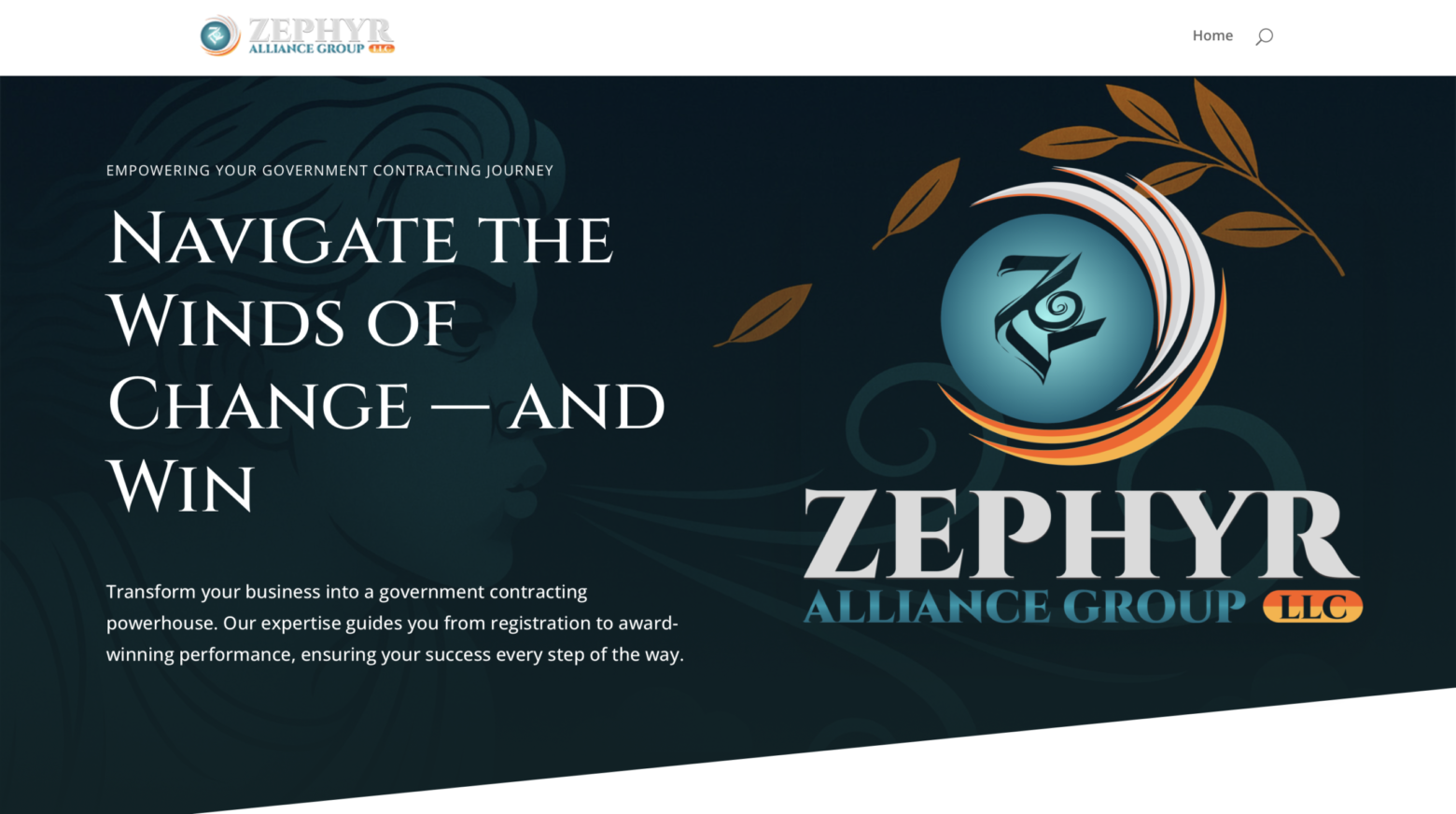
Zephyr Alliance Group, also referred to as ZAG, presents itself as a consulting firm that helps small businesses navigate the US government contracting process. Its website at zephyralliancegroup.com promotes services including SAM registration, certification assistance, capability statement development, and proposal writing support for businesses seeking federal contracts.
The company specifically markets itself to a vulnerable and high-value audience. It targets veteran-owned small businesses, service-disabled veteran-owned small businesses, women-owned small businesses, minority-owned businesses, and other entities seeking entry into the federal contracting space.
However, the BBB Scam Tracker tells a very different story. A confirmed victim, a service-disabled veteran who had already invested $14,000 into a related firm called SelectGCR, lost a further $19,500 after being persuaded to sign a contract with Zephyr Alliance Group. The person behind this is named Adam Moreland. Promises were made, contracts were signed, money changed hands, and then communication stopped entirely.
The BBB Fraud Report Against Zephyr Alliance Group
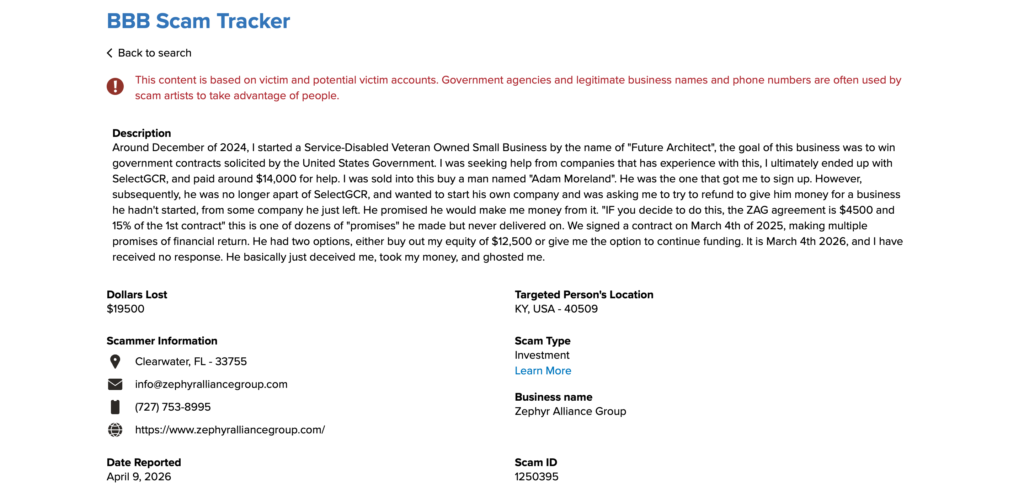
The BBB Scam Tracker holds a formal fraud report against Zephyr Alliance Group. The Scam ID is 1250395. The report was filed on 9 April 2026 and confirmed a victim based in Kentucky, USA. The total dollars lost were $19,500.
The victim describes starting a Service-Disabled Veteran Owned Small Business called Future Architect in December 2024. The business goal was to win US government contracts. While seeking help, the victim engaged SelectGCR and paid approximately $14,000 for assistance. The person who sold them this service was Adam Moreland.
Subsequently, Moreland left SelectGCR. He then approached the same victim seeking money for a new business he had not yet started, telling the victim he would make them money. The victim reports being told: “If you decide to do this, the ZAG agreement is $4,500 and 15% of the first contract.” This was described as one of dozens of promises that were never delivered.
A contract was signed on 4 March 2025. It contained multiple promises of financial return. Moreland presented two options: buy out the victim’s equity of $12,500 or continue funding the arrangement. On 4 March 2026, exactly one year after signing, the victim had received zero response. The victim’s own words in the BBB report state he basically just deceived me, took my money, and ghosted me.
The BBB lists the phone number (727) 753-8995 and the website https://www.zephyralliancegroup.com as associated with this fraud. The reported email is connected to Adam Moreland at Zephyr Alliance Group.
Who Is Adam Moreland and What Did He Do?
Adam Moreland is the individual directly named in the BBB fraud report against Zephyr Alliance Group. According to the victim’s account, Moreland originally worked at SelectGCR, a government contract consulting firm, where he sold the victim approximately $14,000 worth of services.
After leaving SelectGCR, Moreland approached the same victim to invest in the new business he was founding, which became Zephyr Alliance Group. He solicited the victim for money before the business had even formally launched, he made repeated verbal and written promises of financial return, and he structured a contract with an equity buyout clause of $12,500. He took $19,500 in total. Then he vanished.
This sequence of events, specifically targeting a veteran he had already sold services to, soliciting new investment for an unproven business, making undeliverable promises, and then cutting off all contact, is a deliberate fraud pattern. It is not a failed business arrangement. It is a targeted exploitation of trust.
Veterans and small business owners must understand that individuals who move from firm to firm while soliciting personal investment from existing clients, outside of any established business structure, are operating a high-risk scheme that frequently results in the victim losing every dollar invested.
Why This Fraud Specifically Targets Veterans
The victim in this case is a service-disabled veteran who launched a veteran-owned small business to pursue government contracts. This is not a coincidence. Veteran-owned small businesses are a deliberate and specific target for this type of fraud.
Scammers who operate in the government contracting consulting space know that veterans entering the contracting market face a steep and complex learning curve. The federal contracting process involves SAM.gov registration, past performance requirements, certifications, capability statements, and bid preparation. Each of these steps is unfamiliar to most new entrants.
This complexity creates fertile ground for fraud. Consultants can charge large upfront fees, make vague promises about future contract wins, and disappear before any performance is delivered. The victim, unfamiliar with the process, has no immediate way to verify whether the consultant is doing genuine work or not.
Furthermore, veteran entrepreneurs are twice as likely to be targeted for scams compared to non-veterans, according to research cited by multiple federal fraud prevention programmes. They often bring disability payments, separation bonuses, or personal savings into new businesses, making them financially attractive targets.
Zephyr Alliance Group Red Flags: What Every Business Owner Must Know
Every warning sign in this fraud was visible before the victim signed a single contract. Understanding these red flags can protect you and anyone in your network.
Soliciting Investment Before the Business Existed
Adam Moreland approached the victim to invest money in Zephyr Alliance Group before the company was formally established. No legitimate consultant asks clients to fund the business they are about to hire. This is the single clearest red flag in the entire account. Anyone soliciting personal investment from you in a business they have just started or not yet started is not operating legitimately.
Dozens of Unwritten and Undeliverable Promises
The victim described receiving dozens of promises from Moreland, none of which were delivered. Legitimate consulting agreements define services clearly, establish measurable deliverables, and include timelines. Vague promises of financial return are not a substitute for a detailed scope of work. If a consultant’s pitch relies on persuasion rather than documented commitments, that is a serious warning sign.
Moving From Firm to Firm While Targeting the Same Clients
Moreland sold the victim $14,000 worth of services at SelectGCR and then returned to solicit the same victim for a second payment at his next venture. This pattern of following clients across businesses to extract additional fees is a documented fraud tactic. Any consultant who leaves a firm and immediately approaches their former clients for new investment deserves extreme scrutiny.
Equity Clauses With No Accountability Mechanism
The ZAG contract included an equity buyout provision of $12,500. Legitimate equity arrangements in consulting partnerships include clear milestones, verifiable deliverables, and defined exit mechanisms. An equity clause in a contract with a newly formed, unproven business run by a single individual who already left one firm offers essentially no investor protection whatsoever.
Complete Disappearance After Payment
One year after signing the contract and paying $19,500, the victim received zero communication from Adam Moreland or Zephyr Alliance Group. All attempts at contact went unanswered. Legitimate businesses, even those that underperform, do not simply ghost clients who have paid nearly $20,000 and signed formal contracts. Complete disappearance is the definitive final stage of a deliberate fraud.
No Verifiable Track Record of Contract Wins
Legitimate government contracting consultants can point to documented wins. They can name agencies, contract numbers, and client outcomes. Consultants who rely solely on persuasion, personality, and verbal promises, without a verifiable track record, are not in a position to deliver the service they are selling.
Is Zephyr Alliance Group Legitimate? Our Full Verdict
Based on every source reviewed for this Zephyr Alliance Group review, the answer is unambiguous. Zephyr Alliance Group operated as a fraudulent enterprise that deliberately targeted a service-disabled veteran entrepreneur, extracted $19,500 through false promises and contractual misdirection, and then severed all contact precisely one year after signing.
This was not a business that tried and failed. This was a calculated scheme that exploited trust built at a previous employer, used the credibility of a signed contract to legitimise the extraction of funds, and then disappeared without accountability.
The ZAG business model, specifically charging $4,500 as a starting fee plus 15% of a first contract that never materialised, on top of equity arrangements that were never honoured, is a textbook example of a consulting fraud targeting small business owners who do not yet have the experience to recognise these patterns.
We strongly advise every veteran entrepreneur, small business owner, and government contracting consultant to avoid zephyralliancegroup.com and to independently verify the track record of any consultant before signing any agreement or making any payment.
What to Do If You Have Already Paid Zephyr Alliance Group
If you have already sent money to Zephyr Alliance Group or signed a contract with Adam Moreland, take every step below without delay. Time is critical in fraud recovery.
Step 1: Stop All Further Payments Immediately
Do not send any additional money to Zephyr Alliance Group, Adam Moreland, or any associated entity under any name. Additional payment requests, whether framed as equity top-ups, contract continuation fees, or penalty avoidance, are designed to extract more money from you. Stop all payments today.
Step 2: Contact Your Bank or Payment Provider Now
Call your bank or card provider and report the situation. Explain that you sent money to a business that failed to deliver contracted services and has gone completely silent. Request a chargeback or payment dispute. If you paid by wire transfer, ask your bank about recall options. Time limits apply. The sooner you call, the better your chances.
Report the fraud immediately by clicking here.
How to Protect Your Veteran Business From Government Contracting Fraud
Government contracting consulting fraud is a growing problem that specifically targets the veteran entrepreneur community. These steps can protect you before you sign anything or send a single dollar.
Always verify any consultant’s track record before paying them. Ask for documented contract wins. Request agency names, contract numbers, and client references you can call directly. A legitimate consultant with genuine results will welcome these questions without hesitation. One who deflects, offers only vague assurances, or pressures you to commit quickly is not trustworthy.
Never pay a consultant who asks you to fund their business rather than pay for services. There is a fundamental difference between hiring a consultant and investing in a consulting startup. The victim in this Zephyr Alliance Group review was asked to do the latter while believing they were doing the former. These are not the same transaction and they carry very different risks.
Check any consulting firm on the BBB website at bbb.org before signing. Search both the company name and the name of the individual you are dealing with. Also search on Google using the name combined with the words review, complaint, and fraud. This takes under ten minutes and can prevent losses that take years to recover from.
Use the SBA’s free resources for veteran-owned small businesses before engaging any paid consultant. The Small Business Administration offers free assistance through its Veteran Business Outreach Centers located across the country. SCORE also offers free mentoring from experienced business advisers. Many of the services these fraudulent consultants charge thousands of dollars for are available at no cost through official government programmes.
Frequently Asked Questions About Zephyr Alliance Group
Q: Is Zephyr Alliance Group a legitimate government contracting consultant?
Based on a confirmed BBB fraud report filed in April 2026, Zephyr Alliance Group is not operating legitimately. A service-disabled veteran entrepreneur lost $19,500 to this company after Adam Moreland made dozens of undelivered promises and then ceased all contact exactly one year after signing a contract. The BBB Scam ID is 1250395.
Q: Who is Adam Moreland at Zephyr Alliance Group?
Adam Moreland is the individual named in the BBB fraud report against Zephyr Alliance Group. He previously worked at SelectGCR, where he sold the victim $14,000 worth of government contracting services. After leaving SelectGCR, he approached the same victim to fund Zephyr Alliance Group before it was even established, extracted a further $19,500, and then disappeared entirely without delivering any promised results.
Q: What is the ZAG agreement and is it legitimate?
The ZAG agreement refers to the contract structure used by Zephyr Alliance Group. The reported terms included a $4,500 upfront fee and 15% of the first government contract won. The contract also contained an equity buyout clause of $12,500. Based on the BBB fraud report, none of the promised financial outcomes were delivered and all contact ceased after the money was paid.
Q: Can I get my money back from Zephyr Alliance Group?
You may be able to recover some funds depending on how and when you paid. Contact your bank immediately to request a chargeback or payment dispute. File reports with the FTC at reportfraud.ftc.gov and the FBI at ic3.gov. Also report to the VSAFE Fraud Hotline at 1-833-38V-SAFE if you are a veteran. Consult a business fraud attorney who can advise on civil recovery options.
Q: Is SelectGCR also fraudulent?
The BBB fraud report focuses specifically on Zephyr Alliance Group and Adam Moreland after he left SelectGCR. SelectGCR as a company has public testimonials and maintains a separate brand. The victim’s complaint is directed at Moreland personally and at his new company Zephyr Alliance Group, not at SelectGCR itself. Always conduct independent due diligence on any consulting firm before paying.
Q: How do I report Zephyr Alliance Group?
File a report on the BBB Scam Tracker at bbb.org/scamtracker. Report to the FTC at reportfraud.ftc.gov. File a complaint with the FBI at ic3.gov. If you are a veteran, contact the VSAFE Fraud Hotline at 1-833-38V-SAFE or visit vsafe.gov. Preserve all contracts, emails, payment records, and messages as evidence for every report you file.
Q: What free resources exist for veteran-owned small businesses pursuing government contracts?
The Small Business Administration offers free assistance through Veteran Business Outreach Centers across the United States. SCORE provides free mentoring from experienced business advisers. SAM.gov registration and most government certification processes are free of charge. Ptap.sba.gov provides free procurement technical assistance. Never pay for services that the government already offers to veteran entrepreneurs at no cost.
Q: Are government contracting consultants commonly used to defraud veteran entrepreneurs?
Yes. This type of fraud is well documented. Federal agencies including the FTC, VA, and VSAFE all publish specific guidance warning veteran entrepreneurs about consulting schemes that charge large upfront fees, make unverifiable promises of contract wins, and disappear without delivering results. Research shows veterans are twice as likely to be targeted for scams compared to non-veterans, making due diligence essential before engaging any paid consultant.
Q: What phone number and email is associated with Zephyr Alliance Group in the BBB report?
The BBB fraud report lists the phone number (727) 753-8995 and the website https://www.zephyralliancegroup.com as associated with this fraud. An email address connected to Adam Moreland at Zephyr Alliance Group is also referenced. If you have been contacted using these details, do not send any money and file a report with the BBB, FTC, and VSAFE immediately.
Final Warning: Avoid Zephyr Alliance Group and Verify Every Consultant
This Zephyr Alliance Group review has confirmed every indicator of a deliberate consulting fraud targeting a service-disabled veteran entrepreneur. A BBB fraud report confirms $19,500 in verified losses. Adam Moreland exploited an existing client relationship, made dozens of undeliverable promises, signed a contract containing equity and fee obligations, and then went completely silent for over a year.
Do not engage with Zephyr Alliance Group, do not sign any agreement with Adam Moreland, and do not pay any fee, equity contribution, or contract advance to this operation under any name or variation of its branding.
If you have already been affected, contact your bank, the FTC, the FBI, and the VSAFE Fraud Hotline today. If you are a veteran entrepreneur pursuing government contracts, use the free resources provided by the SBA, SCORE, and Procurement Technical Assistance Centers before paying any private consultant.
Please share this Zephyr Alliance Group review immediately. One share could protect a fellow veteran entrepreneur from losing everything they invested in their new business.