Are you looking into Heritage Fidelity Bank before sending any money? You are in the right place at the right time.
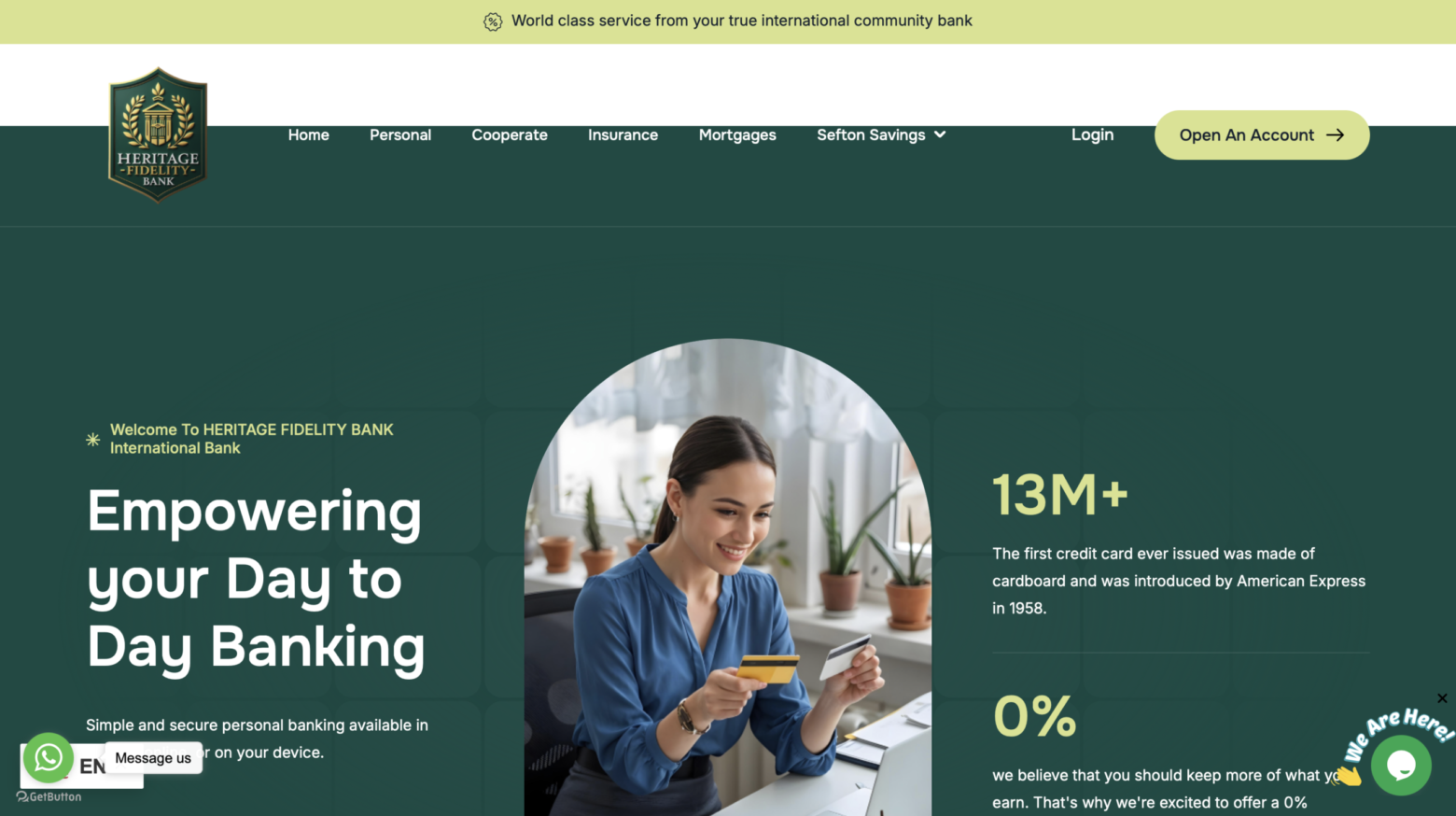
This review exposes Heritage Fidelity Bank as a fraudulent entity designed to steal money from unsuspecting victims. It operates through the website hfb-group.online and has no connection to any licensed financial institution.
We break down exactly how the fraud works, share a documented victim account, and tell you precisely what to do next.
What Is Heritage Fidelity Bank?
Heritage Fidelity Bank presents itself as an online banking institution. It encourages users to open accounts and conduct financial transactions through its website at hfb-group.online.
No regulatory body has licensed this entity as a bank. It does not appear in any official registry of insured financial institutions. Neither the Federal Deposit Insurance Corporation (FDIC) nor any state banking regulator lists it as an authorised institution.
Real banks in the United States are required by law to hold FDIC insurance and register with state or federal authorities. Heritage Fidelity Bank does neither.
According to the Consumer Financial Protection Bureau, fake bank websites are among the fastest-growing categories of online financial fraud. Heritage Fidelity Bank fits this category completely.
How the Heritage Fidelity Bank Fraud Works
Step 1: The Romantic Introduction
The fraud almost never begins with a direct sales pitch. Instead, victims connect with a stranger on a social media platform or dating app.
The relationship develops over several weeks. Conversations feel warm, personal, and genuine. The person builds real emotional trust before mentioning anything financial.
This is intentional. Researchers at the Stanford Internet Observatory have documented how long-term emotional grooming is now the primary tool used in financial fraud operations worldwide.
Step 2: A Shared Financial Goal
Once trust is established, the fraudster introduces a financial opportunity. In many reported cases, this takes the form of a shared property purchase or investment plan.
The victim is told that the fraudster will also contribute funds. Because both parties are supposedly involved, the scheme feels cooperative and safe. The victim lowers their guard significantly.
Step 3: Opening the Fake Bank Account
At this point, the victim is encouraged to open an account with Heritage Fidelity Bank. The fraudster claims the platform makes property transactions or fund transfers faster and more straightforward.
The website looks professional. It uses banking language, account dashboards, and transfer confirmation pages. Everything is fabricated to mimic a real financial institution.
Step 4: Money Appears, Then Gets Locked
The fraudster transfers money into the victim’s new account. The victim can see the balance on their dashboard. However, when they try to withdraw the funds, the bank intervenes immediately.
Heritage Fidelity Bank then demands a collateral payment. This is typically presented as a percentage of the account balance, often around 10%, paid in bitcoin.
Bitcoin payments are required because they cannot be reversed or traced easily. The FBI’s Internet Crime Complaint Center (IC3) consistently warns that any financial institution demanding cryptocurrency as a precondition for a withdrawal is operating fraudulently.
Step 5: The Fee Escalation Trap
After the first payment clears, a second demand appears. Heritage Fidelity Bank claims that “international banking regulations” require an additional 20% payment before the withdrawal can proceed.
This is the core of the advance fee fraud model. Every payment generates a new requirement. Victims pay more and more trying to unlock money that does not actually exist.
Eventually, the victim runs out of money or realises the truth. Communication then stops entirely. The account balance vanishes along with any funds the victim sent as collateral.
Documented Victim Account: $11,900 Lost
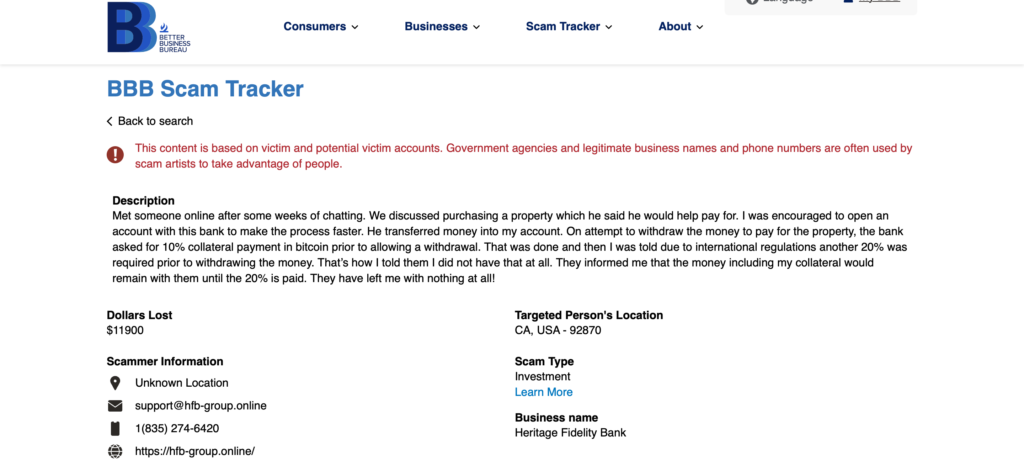
A victim from California shared their experience in a formal fraud complaint. Their account reflects the exact pattern described above.
They met someone online and spent several weeks building a relationship. Together they discussed purchasing a property. The person they met online offered to help fund the purchase.
The victim was encouraged to open an account with Heritage Fidelity Bank to speed up the transaction. Money appeared in the account shortly after. Then came the withdrawal request.
Heritage Fidelity Bank demanded a 10% collateral payment in bitcoin before releasing any funds. The victim paid it. A second demand followed immediately, this time for 20%, again citing international regulations.
The victim could not meet the second demand. Heritage Fidelity Bank then informed them that all funds, including the collateral already paid, would be held until the 20% was received.
Total losses reached $11,900. The victim described being left with nothing.
This is not an isolated case. It is a scripted fraud playbook executed on many victims simultaneously by organised criminal networks.
What Is Advance Fee Fraud and Why Heritage Fidelity Bank Uses It
Advance fee fraud is one of the oldest financial crimes in existence. The principle is simple. The criminal convinces a victim that a large sum of money is available to them. However, the victim must pay a small fee first to access it.
Each fee payment is followed by a new fee. The large sum never arrives. The victim loses every dollar they pay in fees.
Heritage Fidelity Bank executes this model with a modern twist. It uses a convincing online banking interface, romantic grooming, and cryptocurrency payments to make the scheme harder to trace and more believable.
The Federal Trade Commission has published detailed guidance on advance fee fraud. Every tactic Heritage Fidelity Bank uses matches the patterns described in official government fraud warnings.
Red Flags That Expose Heritage Fidelity Bank as Fraudulent
Recognising these warning signs early could save you thousands of dollars.
No FDIC Insurance. Every legitimate US bank displays its FDIC membership. Heritage Fidelity Bank has no such registration. You can verify any bank at FDIC BankFind.
Cryptocurrency Withdrawal Requirements. No legitimate bank ever requires a bitcoin payment before releasing your funds. This demand alone confirms fraudulent intent.
Account Opened Through a Personal Referral Online. Legitimate banks do not recruit customers through romantic relationships on social media.
Escalating Fees With No Upper Limit. Real banking fees are disclosed upfront and fixed. Fees that grow with each payment cycle are a defining feature of advance fee fraud.
No Verifiable Physical Address. Heritage Fidelity Bank has no traceable headquarters, no licensed branch network, and no verifiable leadership team.
Pressure and Urgency. Fraudsters create artificial time pressure. They warn that funds will be forfeited if demands are not met quickly. This tactic bypasses rational decision-making.
Communication Cuts Off Completely. Once a victim can no longer pay, all contact ends. No real bank abandons customers this way.
How to Verify a Real Bank Before Sending Any Money
Protecting yourself starts with a simple verification process. Use these steps before engaging with any online financial institution.
Check the FDIC database. Visit FDIC BankFind Suite and search for the institution by name. If it does not appear, do not send money.
Search for it on the Federal Reserve’s website. The Federal Reserve maintains a list of state-chartered member banks. Cross-reference any institution you are considering.
Verify its domain age. New websites registered within the last year posing as established banks are almost always fraudulent. Use a free WHOIS lookup at whois.domaintools.com to check.
Search the institution’s name with the word “fraud” or “warning.” Victim reports often rank quickly in search results for newer fraud operations. This single step takes two minutes and can save your savings.
Call your own bank first. If someone instructs you to open a new account with an institution you have never heard of, call your existing bank. Ask a representative for their assessment before proceeding.
How to Report Heritage Fidelity Bank Right Now
If Heritage Fidelity Bank has approached you or taken money from you, report it immediately. Every report strengthens the case for investigators and protects future victims.
Report to the FTC. Visit reportfraud.ftc.gov and submit as much detail as possible. Include usernames, email addresses, phone numbers, and transaction records.
File with the FBI IC3. Go to ic3.gov and submit a full internet crime complaint. The IC3 coordinates with federal and international law enforcement agencies.
Contact your bank immediately. Call your bank or credit union the same day. Ask about any available fraud reversal options, particularly for wire transfers or debit card payments.
Report to your state attorney general. Most states maintain dedicated financial fraud divisions. Find your state’s office through naag.org.
File with the FDIC. Because Heritage Fidelity Bank falsely presents itself as a banking institution, you can also file a consumer complaint through the FDIC Consumer Assistance portal.
Save everything before you report. Screenshots, email threads, chat logs, transaction confirmations, and usernames are all critical evidence.
Heritage Fidelity Bank vs a Real Bank: Side by Side
| Feature | Heritage Fidelity Bank | Legitimate Bank |
|---|---|---|
| FDIC Registration | None | Always registered and verifiable |
| Withdrawal Process | Requires bitcoin collateral fee | Funds accessible immediately |
| Fee Transparency | Hidden, escalating demands | All fees disclosed upfront |
| How They Recruit | Romance and social media | Licensed advertising |
| Customer Support | Disappears when payments stop | Permanently accessible |
| Verifiable Address | None | Publicly registered |
| Domain Credibility | New, unverifiable | Established and regulated |
Frequently Asked Questions About Heritage Fidelity Bank
Is Heritage Fidelity Bank a real bank? No. Heritage Fidelity Bank is not a licensed or insured financial institution. It has no registration with the FDIC, the Federal Reserve, or any state banking authority. It operates as a fraudulent platform designed to steal money through advance fee tactics.
What is hfb-group.online? That is the website address Heritage Fidelity Bank uses to present itself as a legitimate banking platform. The website is designed to look professional but has no connection to any authorised financial institution.
How does the Heritage Fidelity Bank fraud start? It typically starts through a dating app or social media platform. Someone builds a romantic or friendly relationship with the victim over several weeks. Then they introduce Heritage Fidelity Bank as part of a joint financial plan.
Why does Heritage Fidelity Bank demand bitcoin for withdrawals? Bitcoin payments cannot be reversed and are very difficult to trace. Fraudsters require cryptocurrency specifically because it eliminates the possibility of chargebacks and makes law enforcement recovery far harder.
I already paid the collateral fee. What should I do now? Stop all further payments immediately. Do not send another dollar regardless of what you are told. Contact your bank, file a report at reportfraud.ftc.gov, and submit a complaint to the FBI IC3 at ic3.gov. Document every transaction and communication you have.
How can I tell if an online bank is legitimate before I open an account? Search for the institution’s name on the FDIC BankFind database at banks.data.fdic.gov. If it does not appear, it is not a real bank. Also check the domain registration age and search for the name alongside the word “fraud” before taking any action.
Final Verdict: Heritage Fidelity Bank Is an Organised Financial Fraud
Heritage Fidelity Bank is not a bank. It is a well-constructed deception that uses romantic trust, professional-looking web design, and escalating fee demands to steal money from real people.
Victims have lost thousands of dollars. Many were left with nothing after paying fees they could not afford. The emotional and financial damage extends far beyond the dollar amounts lost.
If you have encountered this platform, stop all contact and report immediately. Tell anyone you know who may have been approached.
Sharing this article takes thirty seconds. It could prevent someone you care about from losing their life savings.
Sources and Further Reading
- FTC: Advance Fee Loans and Fraud
- FBI IC3: File an Internet Crime Complaint
- FDIC BankFind: Verify Any US Bank
- CFPB: Fraud Tools and Resources
- Stanford Internet Observatory: Romance Fraud Research
- Federal Reserve: Member Bank Directory
- National Elder Fraud Hotline: 1-833-FRAUD-11
- Tradepacefx Scam
- Top Capital Mining Scam
- InMarketHex Scam Review